
HOW ABIOLA LOST JUNE 12 AND HOW ABACHA CAME TO POWER
As Recounted From the Perspective of Chief Tony Anenih
By Aiyekooto Reporters
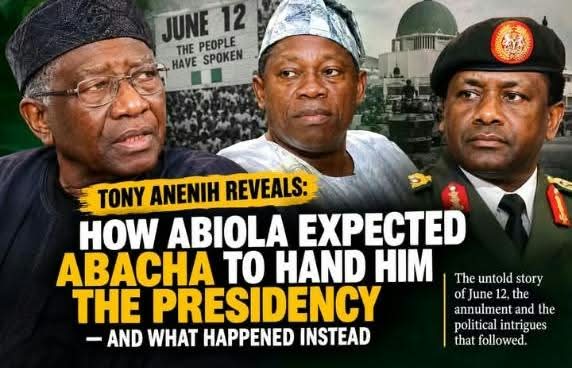
Let me tell you what happened after the June 12 election and how we eventually arrived at the situation in which General Sani Abacha became Head of State.
I was the National Chairman of the Social Democratic Party (SDP). I was therefore not an outsider to the events that followed the annulment. I was involved in the political discussions, the meetings and the negotiations that took place during that difficult period.
To understand what happened, you must first understand the relationship between Chief M.K.O. Abiola and General Ibrahim Babangida.
Abiola trusted Babangida. They were friends, and Abiola believed that Babangida would allow him to become President after winning the election.
But there were problems even before the election was annulled.
Babangida had made promises concerning financial assistance for Abiola’s campaign. When the money did not come as expected, I had to approach a commercial bank to borrow funds to support the campaign.
Abiola became increasingly worried about Babangida’s intentions. He felt his friend was about to embarrass him.
One day, Abiola summoned me to an urgent meeting in Ikeja. Baba Gana Kingibe, Dr. Dele Cole and Kola, Abiola’s son, were also present.
Throughout that meeting, Abiola kept expressing his frustration. He repeatedly said that his friend, Babangida, wanted to embarrass him.
He tried calling Babangida several times, but the calls were being received by Halilu Akilu, the Director-General of the National Intelligence Agency.
Abiola was desperate to speak to Babangida. At one point, he was even prepared to accept becoming President for just one day, after which he would resign.
Imagine the state of mind of a man who had just won a presidential election but was now begging to be allowed to occupy the office, even for one day.
Then came June 23, 1993, when the annulment was announced. The political crisis that followed was enormous.
THE MEETING AT ASO ROCK
After the annulment, Babangida summoned the leadership of the SDP and the NRC to a meeting at the Council Chambers of the Presidential Villa.
At that meeting, he made it clear that the military did not want either M.K.O. Abiola or Bashir Tofa to become President and Commander-in-Chief.
His proposal was that both political parties should conduct fresh presidential primaries and participate in another election.
I objected.
I asked myself: How could we possibly organise fresh primaries and another presidential election within the limited time remaining before Babangida’s promised August 27 handover date?
We had already conducted an election. Nigerians had voted. Why should we start the entire process again?
The NRC Chairman, Dr. Ahmed Kusamotu, appeared more receptive to the proposal. But I maintained my position.
Following my objection, Babangida directed Brigadier-General Halilu Akilu to show me documents explaining why the military did not want Abiola to become President.
That was a revealing moment. It showed that there were issues beyond ordinary political disagreements between the two parties.
Eventually, the proposal for another election gave way to the idea of an Interim National Government. Chief Ernest Shonekan became the head of that government.
We believed the arrangement could provide a transition and eventually return Nigeria to democratic rule. But while we were occupied with these political arrangements, something else was happening.
ABIOLA’S UNDERSTANDING WITH ABACHA
I later discovered that Abiola had been having discussions with General Sani Abacha, who was then Secretary of Defence.
Abiola did not bring the SDP leadership into this arrangement. He kept us out of it.
As I understood it, Abiola believed that Abacha would remove Chief Ernest Shonekan’s Interim National Government and subsequently hand power over to him.
In other words, Abiola believed that Abacha would help him achieve through the military what the annulment had denied him through the ballot box.
There were two possible routes through which Abiola thought this would happen.
The first was what I would describe as the air route. Abacha would remove Shonekan, take over the government and swear Abiola in as President the following day.
The second was what could be called the road route. Under this arrangement, Shonekan would eventually use the National Assembly to facilitate Abiola’s emergence as President, possibly around March 1994.
Abiola believed that either arrangement would eventually deliver the presidency to him. But I considered the whole understanding phoney and hollow. I did not believe Abiola had adequately considered the implications of entrusting his political future to a military officer.
NOVEMBER 17, 1993: THE DAY ABACHA TOOK OVER
Then came November 17, 1993. General Sani Abacha removed Ernest Shonekan’s Interim National Government and assumed power.
Something very interesting happened immediately afterwards. Some politicians who knew about the alleged understanding between Abiola and Abacha gathered at the Nicon Nuga Hotel in Abuja.
They were celebrating. They believed that Abacha’s takeover was simply the first step towards Abiola becoming President. They were shouting: “MKO! MKO!! Presido! Presido!” They expected Abiola to be sworn in.
But that was not what happened. Abacha became Head of State, and there was no indication that he intended to hand over power to Abiola.
Instead, Abacha’s government began presenting the takeover as a legitimate political development.
Abiola and some of his associates paid Abacha a courtesy visit. According to what I observed and understood, Abacha exploited that visit politically. The television footage of Abiola and his associates congratulating him was repeatedly shown on NTA Network News for about two weeks.
Think about the political implication. A man whose election had been annulled, and who was still insisting that he had won the presidential mandate, was now appearing on television congratulating the military officer who had just taken over the government.
The images could easily be interpreted as an endorsement of Abacha’s emergence.
But those who had expected Abacha to hand over power to Abiola were beginning to understand that something had gone wrong.
I WARNED ABIOLA
When it became apparent that Abacha was not going to hand over power, Abiola became increasingly frustrated.
I advised him against declaring himself President. I told him to consider the realities of the situation. Who would enforce his authority? Would the Nigerian Army recognise him? Would the police take orders from him? Would Immigration and Customs recognise his government?
A presidential declaration without the support of the institutions that enforce government authority could expose him to serious danger. I was concerned that he would be arrested.
I did not want him to make a decision that could destroy his political future. I even made my position public through newspaper publications because I wanted Nigerians to know that I had advised him against taking that route.
But Abiola had made up his mind.
JUNE 11, 1994: ABIOLA DECLARES HIMSELF PRESIDENT
On June 11, 1994, Abiola declared himself President of Nigeria. He believed that the June 12 mandate belonged to him and that no military government had the right to take it away.
But the military government was now firmly under Abacha. Abiola was arrested and detained.
The man who had won the June 12 election was now in the custody of the very military establishment whose leadership he had apparently expected to facilitate his emergence as President.
That was how the political calculations unfolded.
SOURCE: Chief Tony Anenih, My Life and Nigerian Politics.