
Beyond the Dance: Lessons from Osun 2026 for Nigeria 2027 (Part II)
By Prof. M.K. Othman
“What really happened during the 2026 Osun gubernatorial election, and what are the implications for the 2027 national elections?”
That question closed Part I of this piece last week. To answer it, we must first appreciate the context and complexity of the Osun election – a rare scene in Nigeria’s political space and a critical lesson for 2027.
The context makes the outcome even more compelling. Governor Ademola Adeleke was originally elected on the platform of the Peoples Democratic Party [PDP], but left the party amid its prolonged leadership crisis and joined Accord in November 2025. Before his arrival, Accord was largely unknown and hardly an electoral colossus in Osun: it had no members in the State House of Assembly and controlled no local government councils.
To be fair, however, it would be misleading to portray Adeleke as a lone man carrying an empty political shell. Much of his political structure followed him. Six Osun members of the House of Representatives subsequently defected to Accord. In contrast, the state PDP structure itself directed its supporters to back his candidacy. Even then, running under Accord against the All Progressives Congress [APC] presented a challenging and fascinating test of an old Nigerian assumption: does the party make the candidate, or does the candidate make the party? A lesson for 2027.
The campaign environment was certainly not genteel. The police announced the deployment of 15,000 personnel for the election, alongside senior officers and other security agencies. Political heavyweights descended on the state. Osun was overnight transformed into a ferocious political battlefield. One politician was even reported to have threatened to silence his opponents. Accusations of intimidation, violence, and partisan use of security institutions circulated before polling day.
Moreover, the election itself was not spotless. Independent observers reported vote-buying and voter inducement. An election-observation coalition, drawing on reports from hundreds of polling units, recorded 323 electoral offences and irregularities by noon on Saturday, including 103 cases of vote trading by different parties and 38 security incidents.
Yiaga Africa subsequently found that INEC’s declared results were consistent with its independent statistical estimates, while warning that this should not be interpreted as certification of every aspect of the process. Vote-buying remained a serious blemish. An election can produce results consistent with votes counted and still contain practices that diminish democratic quality – a lesson for 2027.
There were accounts of inducements tied to political actors throughout the contest. The phenomenon is particularly troubling because vote-buying has gradually become an informal electoral institution in Nigeria. Poverty expands the market, while political distrust, sycophancy, tribalism, and nepotism make it easier to rationalize. A democracy in which citizens must secretly outsmart those attempting to purchase their political rights is already operating below its potential. “Collect the money and vote your conscience” is a typical example.
Yet perhaps the most fascinating part of the Osun story for me is not vote-buying or security deployment, but the persistent political construction of a “Dancing Governor.” I have often wondered about this. Is dancing, by itself, evidence of administrative incompetence? Should a governor not dance? Should President Tinubu not play golf? Should a Vice-Chancellor not be a Chelsea fan, or a judge never laugh at a party, or a surgeon never enjoy a particular genre of music? At what point does recreation become an empirical indicator of leadership failure?
Adeleke has never hidden his fondness for dancing, just as Donald Trump has never hidden his love for golf. After his re-election, the Osun Governor again defended his dancing as a hobby and a way to relieve stress, insisting it does not prevent him from doing his job. Indeed, anyone is perfectly entitled to question his seriousness, because democracy permits satire, ridicule, and political branding. But we must distinguish political imagery from performance measurement. A man may dance badly and govern well, while another may maintain an austere public countenance and govern disastrously. Neither dancing nor solemnity appears in any serious development index. This is where Osun becomes useful as a civic and political education laboratory. A lesson for 2027.
What has happened to internally generated revenue? What is the trajectory of public debt? Are salaries and pensions being paid? How many kilometres of economically useful roads have been completed, and at what cost? What has happened to school enrollment, learning outcomes, maternal mortality, primary healthcare utilization, agricultural productivity, youth employment, and private investment? Are contracts competitively procured? Has the government strengthened institutions or merely personalities? These should be the focus of interrogation. I hope to study the Osun model one day.
Adeleke’s record, as with other state governments, is neither a fairy tale nor a wasteland. An independent pre-election assessment by Premium Times described his four years as a “mixed picture” of the good, the bad, and the ugly. It noted that the administration reduced state debt, increased internally generated revenue, settled portions of inherited salary and pension liabilities, and invested visibly in roads, healthcare, education, and other infrastructure. The same assessment also flagged controversies over project quality and distribution, education expenditure, public-sector management, and the prolonged local government dispute.
These claims, and those of the government, should be independently scrutinized to help voters make informed decisions. That is the main point. The voters were satisfied with the performance of their dancing governor and voted overwhelmingly for him to continue for another four years – Falle Biyu!
I do not make a case for Adeleke, Accord, APC, NDC, ADC, or anyone else. As a Nigerian, I hate to turn political commentary into partisan cheerleading, but neutrality does not require intellectual silence. We can study an election without taking sides – a lesson for 2027.
More importantly, Osun suggests that voters can separate several variables that politicians often bundle together. Party strength matters, but perhaps not absolutely. Federal supremacy matters, but it need not be irresistible and can be rendered impotent. Personality matters, but performance matters more. And in a corrupt atmosphere where money is thrown at voters, money should not necessarily determine what happens behind the ballot screen.
This does not mean the Osun electorate made a perfect decision; rather than guaranteeing wise choices, democracy guarantees the citizen’s right to make the choice. The re-elected governor must now justify that choice, because the new mandate should never be interpreted as a certificate of perfection. It is closer to a renewed performance contract for improved roads, functional schools, working hospitals, new jobs, and defensible public finances. In fact, citizens who voted against the winner must receive the same dividends as those who voted for him.
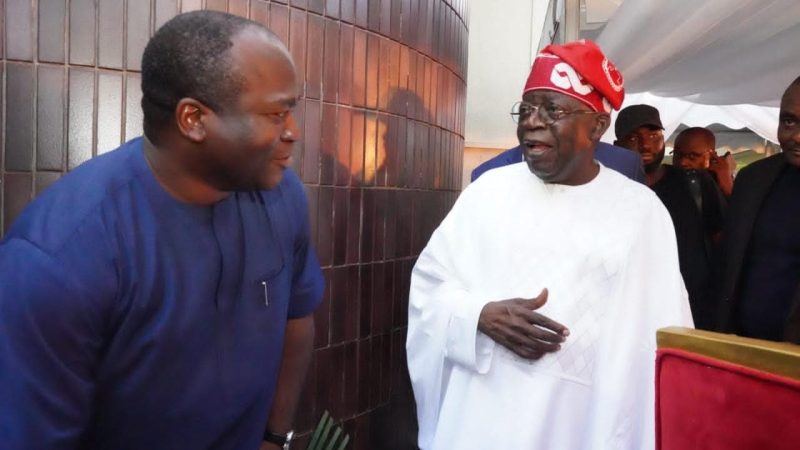
There is also an institutional lesson for our country’s leadership. Shortly before the election, President Bola Tinubu publicly urged Osun citizens to vote for the candidate of their choice without fear and warned that they should not be molested. After INEC announced the results, the President, in a display of sportsmanship and honour, congratulated Governor Adeleke and urged him to unite the state around development. In appreciation of Mr. President’s magnanimity, Adeleke reportedly withdrew a two-billion-naira lawsuit against the Economic and Financial Crimes Commission [EFCC] that had frozen his state’s bank accounts before the election.
In a country where federal might has historically generated anxiety during opposition-controlled state elections, accepting an unfavourable electoral outcome is itself a victory for the APC and an important democratic practice. Nigeria needs more occasions when the party at the centre contests fairly and fiercely, wins or loses somewhere, and the Republic continues. This is what gives me hope for 2027; every contestant should justify why he should be voted for, irrespective of who and what backs him. Gradually, Nigerians are becoming wiser. A lesson for 2027.
The larger destination is 2027, when Nigerians will again be surrounded by slogans, carefully edited videos, religious appeals, ethnic calculations, accusations, endorsements, defections, insults, memes, and probably unprecedented quantities of digital propaganda. Artificial intelligence will make fabricated audio and video even easier to produce. The temptation will be to assess candidates by spectacle: who speaks the best English, who belongs to “our” group, who looks presidential, who has the largest convoy, who controls the biggest party, who dances too much – or perhaps who does not dance at all. Instead, let us demand something more rigorous.
Every serious candidate in 2027 should undergo what might be called a citizen’s performance audit. What has this person managed before? What measurable results followed? What is the candidate proposing, what will it cost, and where will the money come from? What is the candidate’s record on public finance, human capital, security, infrastructure, and institutional integrity? Who surrounds the candidate? Does the candidate tolerate criticism? Are the candidate’s promises consistent with Nigeria’s fiscal realities?
For incumbents, the questions are even simpler: You have had power; what did you do with it? Why do you want another mandate? Can you do better than your first-term performance? What were the roles of your family members during your first tenure? Are they richer now than they were before your first term?
That is how mature electorates gradually reshape political behaviour. When voters reward evidence rather than theatre, politicians eventually invest more in evidence. When citizens punish inflammatory rhetoric, politicians become more careful with their language. When vote-buying no longer guarantees votes, its economics begins to collapse. And when a small party can defeat a large one because voters prefer its candidate, political parties themselves receive a useful warning: their logos are not title deeds to the electorate.
Perhaps the enduring image from Osun should not be of a dancing governor, but of the voter who stands before a ballot paper, momentarily beyond the reach of governors, senators, security convoys, campaign money, social media insults, and political godfathers. In that small space, sovereignty becomes remarkably personal.
Nigeria will enter 2027 with enormous challenges that demand serious choices from all of us. We cannot afford to elect leaders primarily because they dance or do not dance, speak like us, worship like us, come from our region, have the most degrees, or have the most intimidating political CVs or machinery. The questions must return to development, competence, character, evidence, credibility, trust, honour, and achievable policy, and of course, be surrounded by result-oriented team members.
Let every Nigerian have a pastime. Let politicians dance if they wish. Let the electorate choose their pastime as they wish; let me play my squash and chess whenever I want and have time. But when they ask for our votes, let us set aside the music and extracurricular activities and examine the balance sheet.