

The Yar’Adua Family: Arguably Nigeria’s Most Politically Exposed Family
Few families in contemporary Nigeria have touched every era of the country’s politics the way the Yar’Aduas have — from the First Republic in the 1960s, through military rule in the 1970s and 1990s, to civilian democracy in the 2000s and today. They are from Katsina, in Katsina State, and rose through a mix of traditional title, education, military service, and party politics.
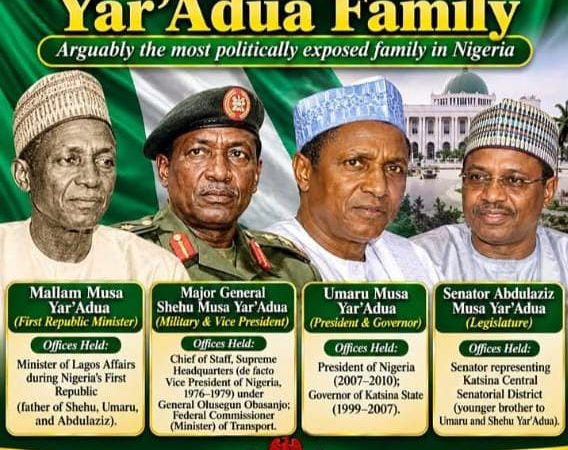
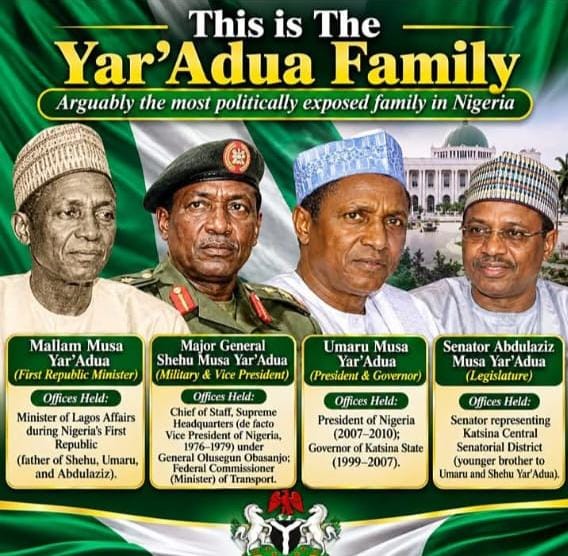
The poster you shared captures the four pillars of that story in one generation.
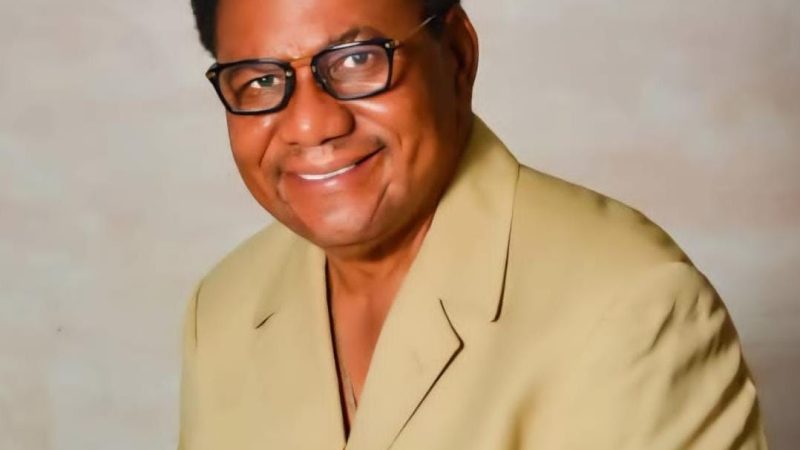
1. Mallam Musa Yar’Adua — The Patriarch
Offices Held: Minister of Lagos Affairs during Nigeria’s First Republic
Musa Yar’Adua was a teacher turned politician who served as Minister of Establishment, Nigerianisation and Training, and later as Minister of Lagos Affairs in the First Republic under Prime Minister Tafawa Balewa.
In Katsina Emirate, he held the powerful traditional title of Mutawallen Katsina — keeper of the treasury — a title his father Malam Umaru had also held before him.
He was married to Hajiya Dada Yar’Adua (1922–2024), who lived to 101 and became known in Nigeria as the mother of a president, a vice-president-in-effect, a governor, and a senator. She died on September 2, 2024.
Musa was the father of Shehu, Umaru, Abdulaziz, and others.
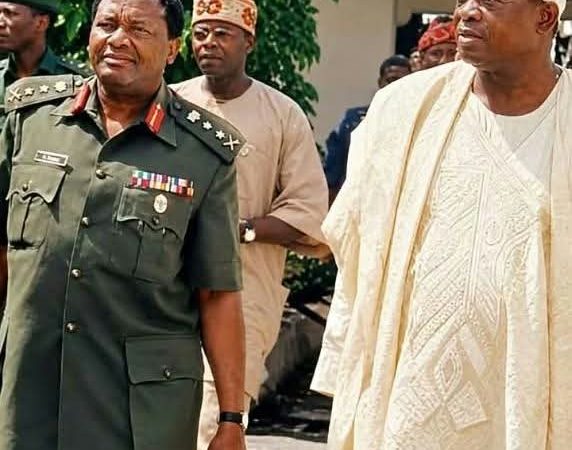
2. Major General Shehu Musa Yar’Adua — The Soldier-Politician
Offices Held: Chief of Staff, Supreme Headquarters (de facto Vice President), 1976–1979; Federal Commissioner (Minister) of Transport
Shehu (5 March 1943 – 8 December 1997) was the son who shot the family name into national limelight. After the 1976 coup, he became second-in-command to Head of State General Olusegun Obasanjo.
He was a central figure in the transition that returned Nigeria to civilian rule in 1979. In the 1990s, he returned to politics as a leading pro-democracy figure, founding the People’s Front, which later became one of the building blocks of the People’s Democratic Party (PDP).
He died in detention in 1997 under the Abacha military regime — a death that made him a martyr of the pro-democracy movement and cemented the family’s moral authority in Nigerian politics.
3. Umaru Musa Yar’Adua — The President
Offices Held: Governor of Katsina State (1999–2007); President of Nigeria (2007–2010)
Umaru (16 August 1951 – 5 May 2010) was Nigeria’s 13th President.
Before the presidency, he served two terms as Governor of Katsina State. As president, he is best remembered in contemporary Nigeria for:
- The 7-Point Agenda — power, food security, wealth creation, transport, land reform, security, and education • The Niger Delta Amnesty Programme (2009) — which ended years of militancy and restored oil production • The Rule of Law doctrine — famously declaring he would obey court orders even when they went against his government • Electoral reform — openly admitting the 2007 election that brought him to power was flawed, and setting up the Uwais Committee to reform elections
His presidency was cut short by illness. His long absence for treatment in Saudi Arabia in 2009-2010 led to Nigeria’s famous “Doctrine of Necessity” crisis, when the National Assembly empowered then-Vice President Goodluck Jonathan to act as President. He died in office on 5 May 2010.
His wife, Turai Yar’Adua, was First Lady from 2007 to 2010.
4. Senator Abdulaziz Musa Yar’Adua — The Contemporary Link
Offices Held: Senator representing Katsina Central Senatorial District
Abdulaziz is the younger brother to Umaru and Shehu, and the family’s active face in contemporary politics.
A retired Colonel in the Nigerian Army, he first sought the Katsina governorship in 2015, and is now in the Senate representing Katsina Central — the same zone his family has dominated for decades.
His presence means the Yar’Adua name is not just history. In today’s National Assembly, Katsina Central is still represented by a Yar’Adua, keeping the family in the room where national budgets, security debates, and constitutional amendments are decided.
Why This Family Still Matters in Contemporary Nigeria
1. A Pilgrimage Site for Presidential Aspirants
Every election cycle, aspirants still visit the Yar’Adua family house in Katsina to seek blessing and endorsement. Analysts describe it as a political pilgrimage because of what the family represents: northern establishment credibility, PDP founding legitimacy, and the memory of Umaru’s “servant-leader” image.
2. A Bridge Across Nigeria’s Divides
The family connects the First Republic, the military era, and the Fourth Republic. Musa served under Balewa, Shehu served under Obasanjo the soldier, and Umaru served as Obasanjo the civilian’s successor. No other Nigerian family has produced a First Republic minister, a military number-two, and a civilian president in direct father-to-sons line.
3. The Katsina Power Base
Katsina is not just their home state — it is now Nigeria’s most politically consequential state in recent history, having also produced President Muhammadu Buhari. The Yar’Aduas helped make Katsina a centre of national power, not a periphery.
4. A Legacy of Reform, Not Just Power
In contemporary debates about electoral reform, Niger Delta peace, and rule of law, Umaru’s short presidency is still cited as a reference point — especially by Nigerians who contrast his quiet, due-process style with more confrontational leadership styles since then.
In short: Musa built the foundation, Shehu built the national network, Umaru reached the highest office, and Abdulaziz keeps the family in active politics today.