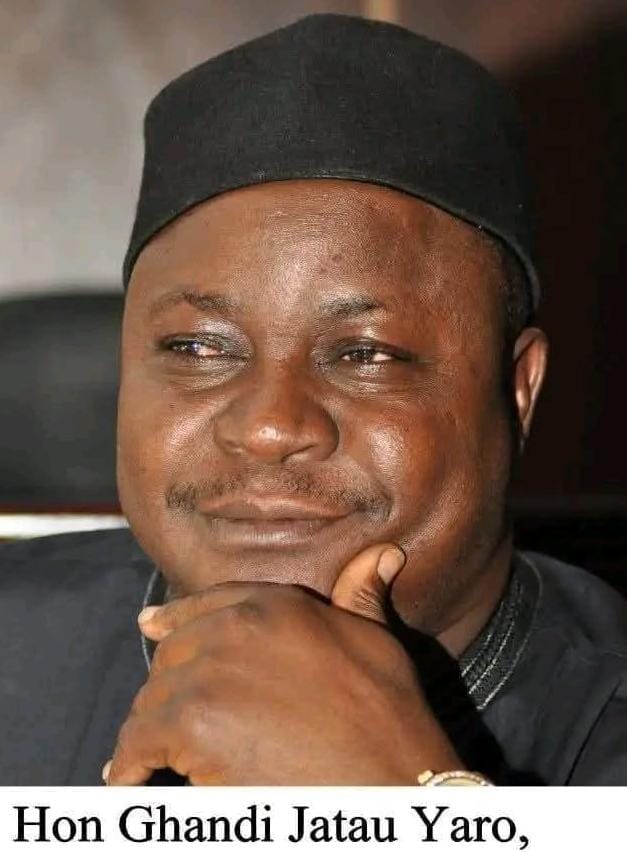
WHEN A GENTLEMAN OF POLITICS LEAVES: REMEMBERING HON. GHANDI YARO JATAU
By Cliff Stanley
“You have fought the good fight, you have finished your race.”
How do we adequately mourn a man who was, at different moments, a politician, strategist, father, uncle, friend, mentor and, above all, a man deeply loved by his family and community?
How do we say goodbye to someone whose presence became part of the political and social story of his community?
And when a man who invested so much of his life in people leaves this world, what remains?
These are not easy questions to answer as we remember Hon. Ghandi Yaro Jatau.
His passing is a painful loss to his immediate family, his friends, political associates, the people of Balanga and the wider political community of Gombe State. Yet, even in grief, there is something deeply beautiful about remembering a life that touched people in different ways.
A Gentleman of Politics
Ghandi was not simply a politician. He was a gentleman of politics — a man who understood the calculations, relationships and difficult negotiations that accompany public life, but who also understood that politics should never strip one of humanity.
He was a planner. He understood political timing, relationships and the importance of knowing the terrain. But behind the strategist was a man who valued people. That human dimension perhaps explains why his name will continue to evoke memories far beyond political contests and public offices.
For years, Hon. Ghandi Yaro Jatau was part of the political conversation in Balanga Local Government Area and Gombe State. His political journey reflected the realities of grassroots politics, where politics is not simply about manifestos and campaign speeches, but about relationships, community expectations, personal sacrifice and the ability to remain connected to the people.
His engagement with the Gombe State House of Assembly further placed him within the institutional story of representative politics in the state. His experience gave him an understanding of how community aspirations intersect with government, party structures and public institutions.
But perhaps the more important question is not: What political office did Ghandi occupy?
The deeper questions are:
How many people felt represented because he was there?
How many conversations did he have with people who needed someone to listen?
How many younger people found encouragement in his words?
How many political relationships did he build that survived beyond the immediate demands of elections?
How many people will now discover, in his absence, just how much his presence meant to them?
These are the questions that transform a political biography into a human story.
Beyond Politics: The Family Man
Every public figure has a private story. Beyond the meetings, political discussions and public engagements, there was Ghandi the family man.
He loved his family. He cared about the people close to him and cherished relationships. To his family, he was not a politician first. He was a father, a husband, a brother, an uncle — a relative whose presence carried meaning in the ordinary moments of life.
A political office can tell us what a person did publicly, but it cannot fully tell us who that person was at home.
Who was Ghandi when the political meetings ended? Who was he when there were no cameras? Who was he when he sat with family and friends? Who was he to the people who could simply call him Daddy, Brother, Uncle or Friend?
Those are the memories that will become most precious to his family in the days ahead. For them, this is not the passing of a political figure. It is the absence of someone whose voice, laughter, advice and presence had become part of their lives.
A Lesson in Faith
Some people teach us through formal instruction. Others teach us simply by the way they live. Ghandi belonged to the latter.
For those of us who knew him, his conversations carried lessons about life, politics, relationships, patience and the unpredictability of human affairs.
One lesson remains particularly powerful: “In life, leave everything to God.”
There is profound wisdom in those words. For someone who participated in the competitive world of politics — where people plan, calculate, negotiate and sometimes face disappointment — to ultimately place his confidence in God reflects a profound understanding of human limitation.
We make plans. We work hard. We pursue opportunities. We build relationships. We contest elections. We defend causes. But ultimately, there are dimensions of life that remain beyond human control. Ghandi understood this. Perhaps that is why faith remained an important part of his identity.
The Measure of Leadership
From the perspective of political science, Ghandi’s life offers a reflection on grassroots leadership. Politics is often measured through elections, offices, votes and influence. But leadership should also be measured by something less tangible: the quality of relationships a leader builds and the dignity with which he treats people.
This is where political science and public theology meet. Public theology asks: What kind of person should one become while participating in public life? It reminds us that public leadership is ultimately a moral responsibility. Power is temporary. Influence changes hands. Political alliances shift. Offices come and go. But character leaves a longer shadow.
Ghandi’s story therefore challenges those who remain in public life. What will we do with the opportunities entrusted to us? Will politics make us more compassionate or more cynical? Will power make us inaccessible or more available to the people? Will political competition destroy friendships, or can disagreements coexist with dignity?
And when our own political journeys eventually come to an end, what will people remember about us?
A Legacy of Memories
The true measure of a life is rarely contained in a résumé. It is found in memories. It is found in the people who say, “He helped me.” It is found in those who remember a conversation years later. It is found in the family that remembers the sacrifices of a father, in the friend who still hears his voice in moments of reflection, and in the younger person who remembers being encouraged by an older mentor.
That is the legacy Ghandi leaves behind. Not a perfect life — because no human life is perfect — but a life that carried meaning through relationships, public engagement, family and faith.
To the family of Hon. Ghandi Yaro Jatau, words may not be sufficient to fill the space his departure has created. But may you find comfort in knowing that you are not alone in your grief. Your loss is shared by friends, political associates, community members and many others whose lives intersected with his.
You will miss his voice. You will miss his counsel. You will miss his presence at family occasions. You will miss those little things that, while he was alive, seemed ordinary but which death has now made extraordinarily precious. Yet may those memories become treasures rather than merely wounds.
When you remember him, remember not only the day he left. Remember the years he gave. Remember the love he showed. Remember the people he encouraged. Remember the family he cherished. Remember the wisdom he shared. And remember his enduring counsel: leave everything to God.
A community does not lose a public figure only when an office becomes vacant. It loses a familiar voice. It loses a participant in its political history. It loses someone whose relationships and experiences formed part of its collective memory.
Ghandi’s departure therefore invites the people of Balanga and Gombe State to reflect, not merely to mourn. What kind of political culture are we building? Can politics still accommodate friendship? Can disagreement exist without hatred? Can ambition coexist with humility? Can public service remain anchored in humanity?
There comes a moment when every political calculation ends. The campaign ends. The meeting ends. The argument ends. The ambition ends. The applause becomes silence. And what remains is the person we became while we were here.
Hon. Ghandi has now completed his earthly journey. For those who loved him, the pain is real. For his family, the silence will be profound. For his friends, the memories will remain. For his political associates, an important chapter has closed.
But for those who believe in the sovereignty and mercy of God, death is not the final author of the story. Ghandi’s political journey has ended, but the values he embodied — friendship, family, service, strategic thinking, mentorship and faith — can continue to speak through those he left behind.
Perhaps this is the most fitting way to remember him: Not simply as the politician who died, but as the man who lived. A father. A friend. A mentor. A gentleman. A political strategist. A man who loved his people. A man who cherished his family. A man who believed that, after all human efforts have been exhausted, there is wisdom in placing everything in the hands of God.
So, Hon. Ghandi Yaro Jatau, how do we say goodbye? Perhaps we do not. Perhaps we simply say:
Thank you for the journey.
Thank you for the conversations.
Thank you for the friendships.
Thank you for the lessons.
Thank you for the memories.
You fought your battles. You played your part. You served in your generation. And now, you have finished your race.
May the Lord whom you trusted receive you into eternal rest, and may He grant your family, friends and all who mourn you the strength to carry forward the best of what your life represented.
Rest in perfect peace, Hon. Ghandi Yaro Jatau.
Cliff Stanley
Political Scientist | Public Theologian
cliffstanley3@gmail.com | 07032826319